
Where can I develop this skill? Where else could I use it? What could I learn next?
These are simple questions faced by learners and workers across the country, but our skills system does not always make them easy to answer. This article builds on the first two pieces in this series. The first established a human-centred definition of skill. The second explained why the National Skills Taxonomy (NST) needs a stable hierarchy with many ways to find a skill.
Jobs and Skills Australia’s skills definition recognises that skills are dynamic and shaped by context. A skill does not exist in isolation. Its development and application are influenced by a person’s knowledge, experience, attributes and environment.
Likewise, skills are not tied to a single institution, qualification or job. They develop throughout our lives through education and training, work, volunteering, caring responsibilities and everyday experience, and are applied across many settings and contexts.
Yet the connections between where skills are learned and where they can be used are often difficult to see. A skill gained in one context may be highly valuable in another, but without clear ways of linking that information, its broader relevance can be overlooked.
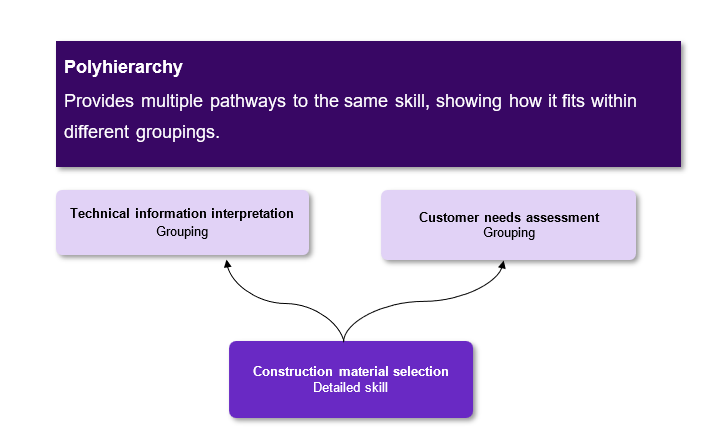
The NST responds by creating a common language for describing skills across education, training and employment systems. Its taxonomy provides a stable structure and one authoritative record for each skill. The same skill can be found through more than one pathway, without creating duplicate records. These connections are called polyhierarchical relationships: different routes to the same skill.
Skills have meaning when connected to people and context
Consider Alex, a jobseeker who has spent several years selling building supplies. Alex works closely with builders, tradespeople and suppliers, helping customers select products, interpret specifications, estimate material quantities and understand project requirements.
Through this experience, Alex has developed skills in communication, problem solving, interpreting technical information and understanding requirements. Alex has also acquired practical knowledge of construction materials, building methods and project workflows.
These skills have meaning because of how Alex has developed and applied them. Although acquired in a retail setting, some may also be relevant in other occupations and contexts. Recognising that possibility requires more than matching labels. It requires clear connections supported by evidence, with agreed rules for how they are maintained.
Alex is considering moving into construction estimating. The skills Alex already uses may provide a foundation, but Alex may need further learning or assessment, or evidence of those skills. The NST could make these connections easier to see without deciding whether Alex is qualified or suited to the role.
Making those connections visible could benefit Alex and the wider economy. According to Jobs and Skills Australia’s analysis, there is a regional shortage of Construction Estimators. Construction Estimators sit within the broader Architectural, Building and Surveying Technicians occupation group, for which median weekly earnings are around $2,280 – more than the median weekly earnings of $1,241 for Sales Assistants (General). The NST could make it easier for Alex to see potential pathways into higher-paying, in-demand occupations. At a system level, helping more people recognise where their existing skills may be relevant could help employers access a wider pool of skills to fill workforce gaps.
An ontology can turn a common skills language into useful connections
The next step is to show how skills connect to learning and work, not just make them easier to find. Jobs and Skills Australia is extending the NST beyond organising skills to describing how they connect to learning, occupations and the settings in which they are developed and used. This approach is called an ontology.
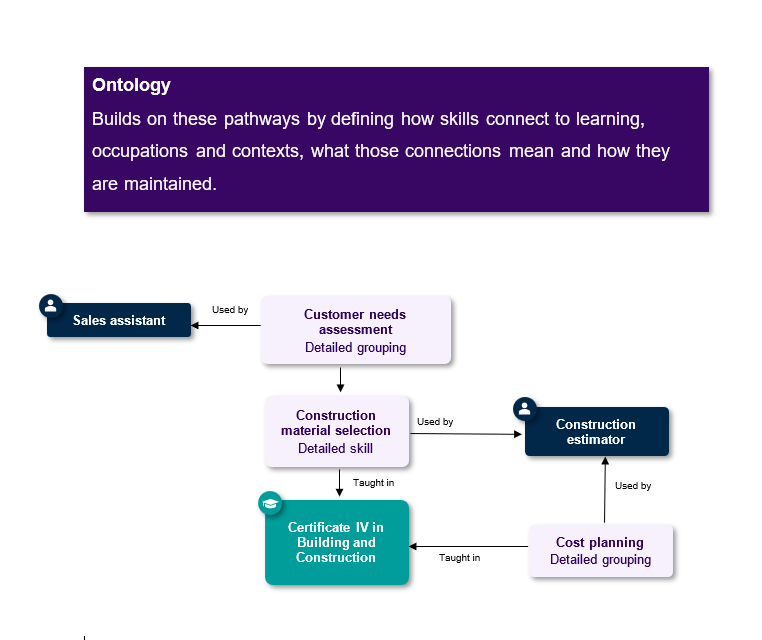
It is not enough to record that two things are connected. An ontology defines the kind of relationship involved. Supporting evidence and governance arrangements establish how that relationship should be interpreted, who maintains it and how it is kept up to date.
The ontology therefore builds on, rather than replaces, the taxonomy and polyhierarchical approach outlined in our previous article. Together, they can turn a common skills language into consistent, useful connections.
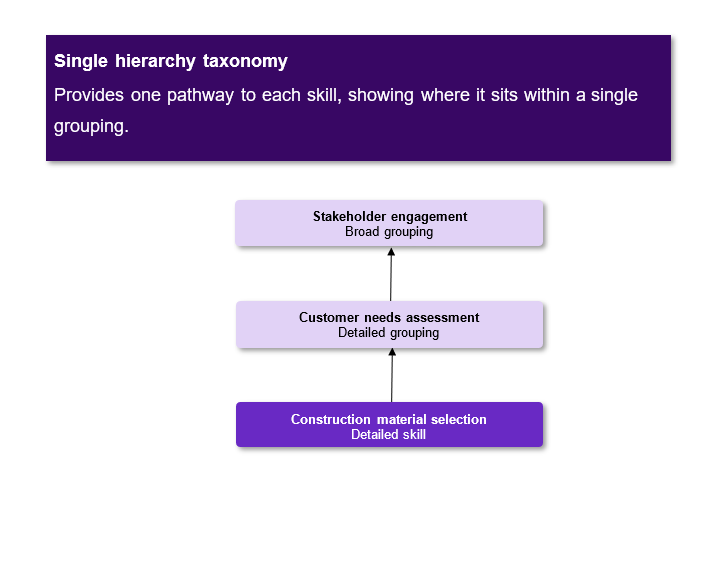
A taxonomy organises skills. Polyhierarchical relationships provide more than one useful way to find them. An ontology describes how skills connect to learning, occupations and contexts, with rules for how those connections are defined and maintained.
Returning to Alex, the taxonomy can provide consistent records for skills such as interpreting technical information and estimating quantities. Polyhierarchical relationships can make those same skills easier to find through different pathways. The ontology could, for example, show whether interpreting technical information is used in an occupation, developed through learning described by a learning outcome, contributes to a broader grouping of skills or is applied differently in a particular context. The formal relationship types and their definitions remain subject to design, testing and approval.
These connections do not prove that a person can perform a skill to the required standard, guarantee that it can be used in another setting, award credit or equivalence, or prescribe a career decision. Evidence, assessment and judgement remain with the people and institutions responsible for them.
The figures below are illustrative only and are intended to demonstrate the concepts of taxonomy, polyhierarchy and ontology. They do not represent or pre-empt future NST design choices.
These connections make skills-first practical
These connections support Australia’s move towards a skills-first approach. Skills-first highlights what people can do, not just the jobs they have held or the qualifications they hold.
By showing relationships between skills information and real-world contexts, an ontology can make a skills-first approach more practical while keeping people and institutions in control.
Better connected skills information can support:
- individuals to understand their skills, explore where those skills may be valued and identify what they may need to learn next
- employers to describe changing skill needs and recognise relevant experience developed in other settings
- education and training providers to connect learning outcomes more clearly with skills and work contexts
- policymakers and workforce planners to better understand pathways and connections across systems.
The ontology connects existing systems rather than combining or replacing them. It does not bring all skills, occupations, qualifications and learning information into one uniform system.
Qualifications remain the responsibility of education and training institutions and relevant regulatory arrangements. Occupations remain defined through appropriate occupational classifications, and learning outcomes remain part of courses and training products. The ontology can connect information across these systems while preserving their different purposes.
Jobs and Skills Australia has endorsed the use of an ontology to extend the NST beyond classification. Detailed relationship types, evidence requirements, governance arrangements and user-facing services remain subject to further design, testing and approval through established NST governance. This work will build on the taxonomy and polyhierarchical approach so that each element contributes to a trusted and maintainable common skills language.
A common skills language becomes useful when it helps people see meaningful connections. By defining and governing those connections, the NST ontology can support better exploration of where skills are developed, where they may be valued and what further learning may be useful, while leaving evidence, assessment and decisions with the people and institutions responsible for them.
Want to know more?
Join our webinar ‘Connecting skills across education and occupation’ on Monday 30 November 2026, 11:45 am – 12:30 pm AEDT.
Date
Category
Opinion piece

