Australia is building a skills-first system. However, a skills-first system that can't properly define "skill" is like a GPS without coordinates: technically functional but practically useless.
How we define skill determines who is recognised, trained and rewarded, yet many vital capabilities, especially those deemed ‘soft’, ‘invisible’ or ‘non-technical’, remain overlooked. A fairer, more adaptable workforce demands a broader, more inclusive understanding of skill.
For decades, we've treated skills as task lists. Can you operate this machine? Complete this procedure? Produce this output? That approach served an industrial economy where jobs were stable and work was predictable.
That economy no longer exists.
Around 21% of occupations have medium to high likelihood of automation due to generative AI. Roles are blending across traditional occupational boundaries. The World Economic Forum estimates 39% of core skills will change by 2030. The average Australian worker is expected to change occupations 2.4 times by 2040. And yet our skills infrastructure, the way we describe, recognise and credential capability still largely depends on frameworks designed for a world of fixed jobs and linear careers.
If we want a system that puts skills first, we need to get the definition right.
What we mean by "human-centred"
Jobs and Skills Australia has developed a national definition of skill to underpin the National Skills Taxonomy (NST):
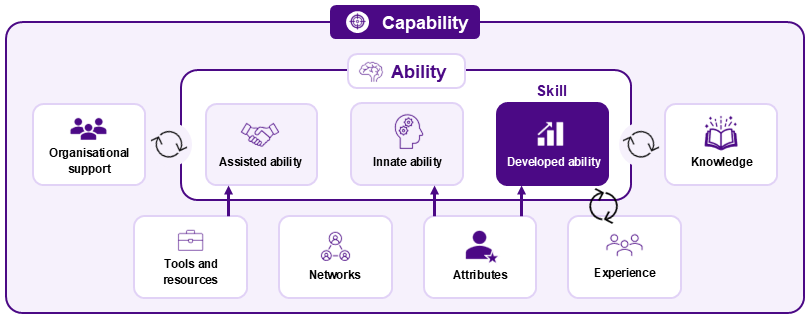
"A skill is a valued and purpose-driven human ability that is acquired or refined through learning and practice. It is a dynamic function of an individual's knowledge, experience, and personal attributes that is continuously influenced by context, interaction with others, and the demands of the environment in which it is exercised."
This is not academic abstraction. It is a design decision with real consequences for how skills get described, measured, recognised and rewarded.
The definition makes four claims that matter:
- Skills are human. Technology augments, accelerates and automates. But the ability to exercise judgement, build relationships, reason ethically and adapt to ambiguity is distinctly human. AI can schedule care shifts or flag anomalies in data, but only a person can provide emotional support in a crisis, negotiate a complex stakeholder relationship, or apply cultural knowledge to land management. As AI takes over more routine work, these capabilities become more economically important, not less.
- Skills are dynamic. They are not fixed competencies that someone either has or doesn't. They are built through learning and practice, refined through experience, and exercised differently depending on demands. A nurse's communication skill at triage is different from their communication in palliative care; same person, same broad capability, different depth, different consequences.
- Skills are shaped by context. Skills rarely operate in isolation. A project manager simultaneously applies stakeholder management, risk assessment, communication and adaptive planning. These skills span multiple domains but are cognitively interdependent in practice. Stripping them apart into disconnected checklist items loses the very thing that makes the work complex and valuable.
- Skills connect to the whole person. Knowledge, experience, personal attributes – these are not separate from skill. They are what give skill its depth. First Nations knowledge systems demonstrate this clearly: as Tyson Yunkaporta explains in his book Sand talk, knowledge emerges through relationship, context and Country, not as isolated competencies to be extracted and listed. A truly inclusive definition must recognise diverse ways of knowing and practising skill.
Why task-based definitions are no longer enough
For much of the twentieth century, skill was understood primarily through the lens of industrial management theory: observable, measurable behaviours tied to specific tasks. That worked when the goal was to describe whether someone could operate machinery or follow a procedure.
But modern work demands more. Communication, adaptability, collaboration, problem-solving, ethical reasoning and leadership are central to performance across sectors. They are also cognitively demanding, contextually variable and difficult to reduce to task descriptions.
A task-based definition cannot capture this. And what definitions cannot capture, systems cannot recognise. What systems cannot recognise, economies cannot value.
This is not a theoretical problem. The Fair Work Commission's Gender Undervaluation Award Review and JSA's Gender Economic Equality Study both demonstrate that skills exercised predominantly in female-dominated sectors - care, education, hospitality - have been systematically undervalued. The language we use to describe skill is part of the reason why.
The NST turns definition into infrastructure
A definition is necessary but not sufficient. To be useful at scale, it needs translation into a structured, consistent way of describing skills across systems.
That is what the NST does.
The NST is a common skills language for Australia. It provides a way to describe skills across education, training and work so that systems can better compare, recognise and connect skills information. It is enabling infrastructure, not a replacement for qualifications, occupational frameworks, industry expertise or jurisdictional responsibilities.
This distinction matters. A skills-first approach does not ask the system to abandon existing structures. It provides a way to see the skills within and across those structures more clearly.
Over time, NST-enabled systems can support:
- clearer career transition pathways based on skill similarity, not just job titles
- better alignment between what employers need and what education develops
- recognition of skills built through multiple pathways, including informal and on-the-job learning
- more equitable valuation of work that relies on human-centric capabilities.
Companies that have adopted skills-based approaches are already seeing results. Research shows skills-based hiring is five times more predictive of job performance than hiring for education alone. Workers matched by skills rather than titles qualify for more than three times as many roles. And organisations using skills-based talent searches are 12% more likely to make quality hires.
These are not marginal gains. They are system-level improvements in how well we connect people to opportunity.
Getting this right requires trust
The NST is being built in stages; deliberately.
A common skills language will only work if it is trusted by the people and institutions that use it. That requires careful governance, quality assurance, practical testing and genuine engagement with the sectors that will adopt it.
The development process has already been informed by consultation, pilot testing and independent assurance. That work has reinforced what many stakeholders said clearly: a precise definition of skill is paramount.
This is the foundation. What gets built on it – the taxonomy structure, the use cases, the integration with other systems – depends on getting the definition right and building confidence through demonstrated value.
Want to know more?
Register for our webinar 'Defining "skill" as human in a changing world' on Tuesday 8 September 2026, 11:45 am to 12:30 pm AEST.
Megan Lilly is Acting Commissioner, Jobs and Skills Australia.