In the first article in this series, Jobs and Skills Australia explained why a skills-first system needs a human-centred definition of skill.
The definition:
"A skill is a valued and purpose-driven human ability that is acquired or refined through learning and practice. It is a dynamic function of an individual's knowledge, experience, and personal attributes that is continuously influenced by context, interaction with others, and the demands of the environment in which it is exercised."
This definition treats skill as a valued and purpose-driven human ability, developed through learning and practice and shaped by knowledge, experience, personal attributes and context.
The next question is practical: how can Australia organise thousands of skills so people and digital systems can find, compare and connect them across education, training and work?
A useful skills taxonomy needs a clear and consistent structure. But a hierarchy alone cannot fully show how skills are developed, combined and applied across education, training and work.
From a definition to a usable system
A taxonomy provides a systematic way to name, describe and organise information into a hierarchical structure. The National Skills Taxonomy will establish a common skills language for Australia through a clear hierarchy.
This hierarchy organises skills from broad groups into increasingly specific groups. Within that hierarchy, each skill will have a consistent name, description, identifier and clear relationships with other information.
However, a skill’s position in the hierarchy will not, by itself, show what capabilities are built upon that skill or the occupations and settings where that skill is relevant.
For example, problem-solving may contribute to many broader capabilities and be used across almost every occupation. In contrast, a highly specialised technical skill may depend on specific occupational knowledge, equipment, standards or safety requirements.
Both problem-solving and specialised technical skills need a clear place in the taxonomy. To understand how they are used in practice, we need to connect these skills to broader capabilities and the occupations and settings in which they are applied.
One skill with more than one way to find it
Think of a library book about technology, education and public policy.
The library maintains one catalogue record for the book, but readers can find the book listed under 3 subjects. The book is not duplicated. It is simply discoverable through more than one pathway.
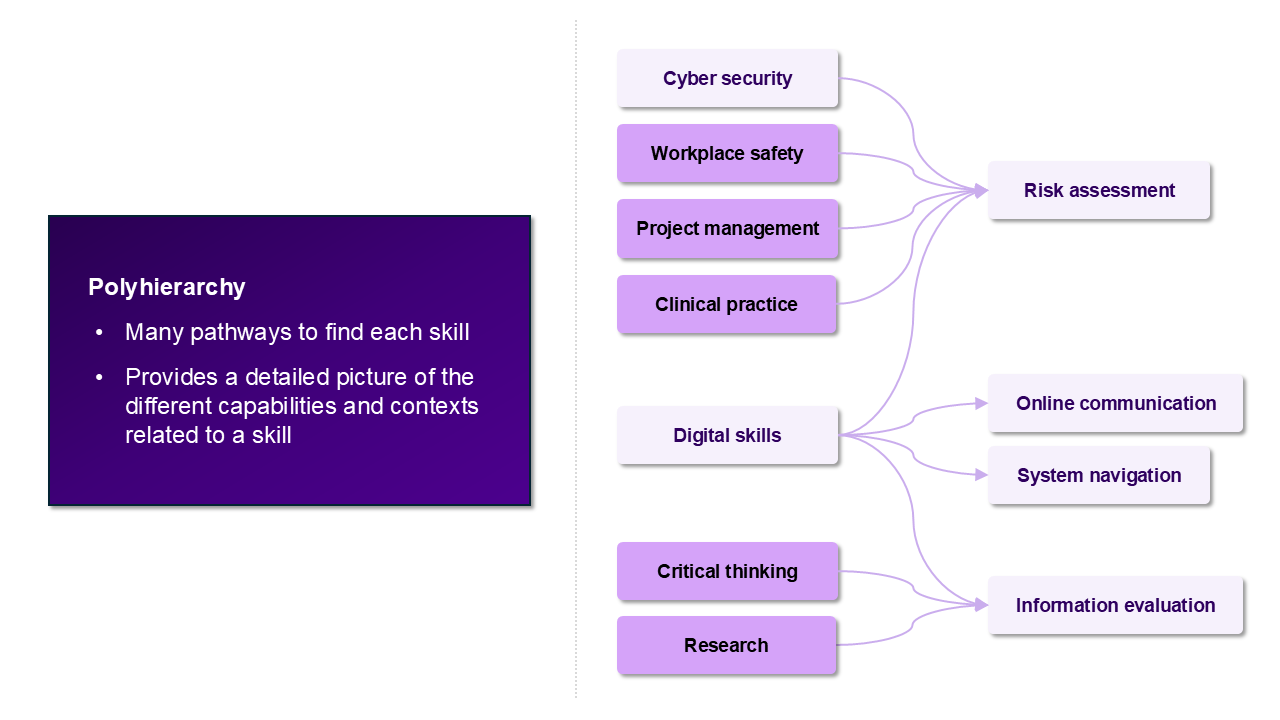
This is a polyhierarchy: an information structure that allows the same item to be found through more than one valid pathway without duplicating it.
For the National Skills Taxonomy, a polyhierarchical approach would retain one record for each skill, while enabling additional groupings for purposes such as capability, occupation, industry, learning area or context. This would help people find a skill from different perspectives and understand where it may be relevant.
Information evaluation, for example, may contribute to digital skills, critical thinking and research. Risk assessment may be relevant to cyber security, workplace safety, project management and clinical practice.
In each case, the skill would retain the single name, description, identifier and position maintained in the taxonomy. Additional relationships could connect it to several relevant groupings without duplicating the skill or changing its place in the hierarchy.
This can help reduce duplication, inconsistency and bias that may arise when the same skill is defined or classified differently across systems.
Skills are influenced by context
Including a skill in multiple groupings does not mean every application of that skill is identical or interchangeable.
Risk assessment in cyber security involves different knowledge, standards and tools from risk assessment in clinical practice. The connection indicates a shared foundation. It does not mean that a person who can apply the skill in one setting can automatically apply it in another.
The same applies to digital skills.
Someone using an online government service and a care worker using a digital record system may draw the same basic underlying skills. However, the care worker must also apply occupational knowledge, protect patient confidentiality and meet professional requirements.
Building connections beyond the hierarchy could show what these applications share while preserving the importance of context. This reflects the human-centred definition: a skill is shaped by a person’s knowledge and experience, the purpose of the activity, interaction with others and the demands of the environment.
What this could enable
For people
People may recognise that they can evaluate information, solve problems and communicate clearly without knowing where else those skills may be relevant. Different groupings could help them identify skills developed through work, learning, caring or community participation and explore related occupations and learning opportunities.
To be clear, the taxonomy cannot confirm that a person is skilled enough for a job, nor can it show how context affects the way a skill is applied. What it can do is reveal potential connections and a clear definition for each skill.
For example, skills used to evaluate information, protect personal data and solve problems in one digital system may provide a foundation for learning another. The taxonomy can make that connection visible, giving the person and those advising them a better starting point for considering what may transfer and what further learning or evidence may be needed.
For employers and workforce planners
Employers and workforce planners can use a common skills language to describe workforce needs more consistently and look beyond job titles. For example, a team adopting artificial intelligence (AI) may need not only technical specialists, but also people who can evaluate information, manage risk, communicate change and exercise professional judgement.
Polyhierarchical connections can help employers identify occupations or workforce segments in which related skills may be developed. Recruitment and skills assessments will continue to require appropriate evidence and human judgement.
This approach can also support workforce planning by showing that an emerging workforce need may involve a new combination or application of existing skills, rather than requiring an entirely new occupation or training pathway.
For education and training providers
Education and training providers can use a shared skills language to describe relationships between learning outcomes and identify where further development may be needed. For example, a learner might have the digital skills to navigate systems and communicate online but need further development in evaluating AI-generated information or assessing privacy and security risks.
The taxonomy can help providers describe the relationship between the skills a learner has and those they still need to develop. It does not award credit, assess proficiency or replace provider judgement.
This could support more targeted learning pathways that build on skills that have been appropriately assessed or otherwise evidenced, rather than assuming every learner must start from the beginning.
A taxonomy is only the starting point
A hierarchical structure provides the necessary starting point for a common skills language. It allows governments, employers, education and training providers, and digital systems to refer to the same skill consistently, making skills information easier to compare, share and connect.
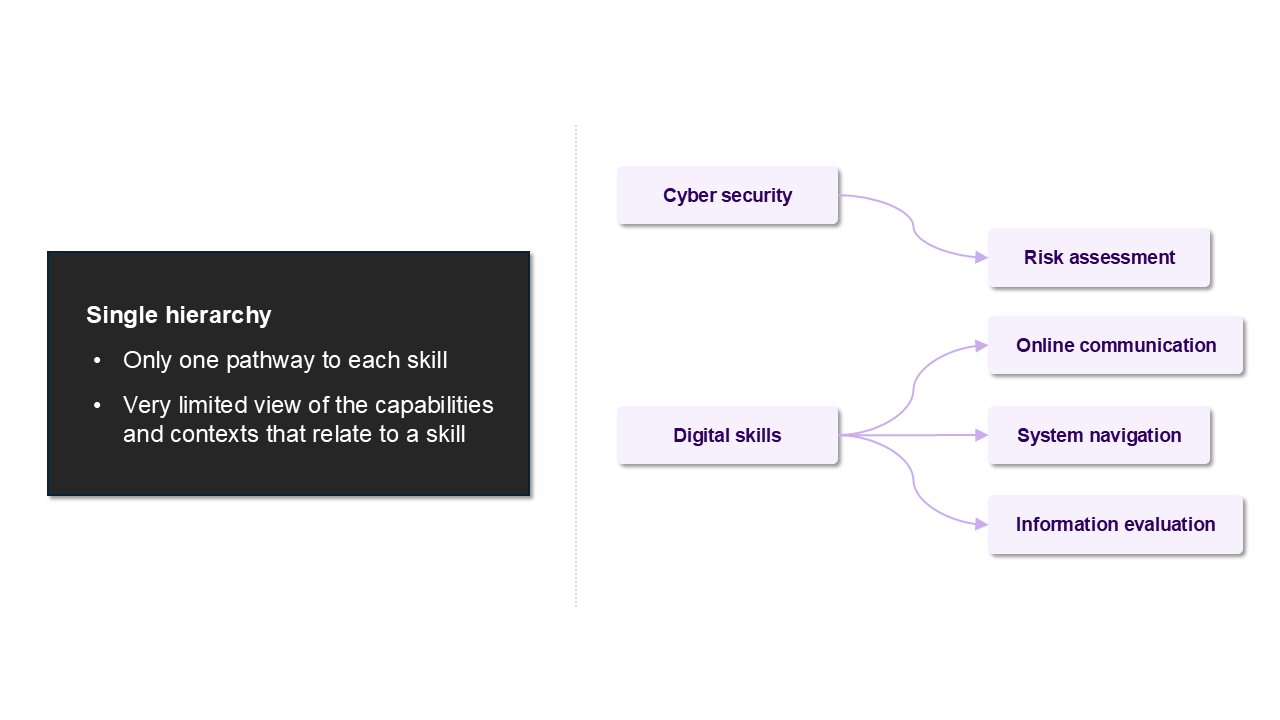
But a single hierarchy can show only one structured view of skills. It cannot fully represent how skills combine, derive meaning from context or contribute to different capabilities across occupations and settings.
A polyhierarchical approach overcomes this limitation by creating pathways for different users. It retains one source of truth for each skill while providing various ways to find and understand it. The National Skills Taxonomy therefore needs both a stable hierarchy and connected pathways around it: one source of truth for each skill, with more than one useful way to find and understand it. It will not replace qualifications, occupational frameworks, evidence, assessment or human judgement. Decisions about proficiency, equivalence and transferability will remain with the responsible people and institutions.
The next article will consider what needs to come after the hierarchy, including how user-facing products and services could help people demonstrate and use their skills while keeping context, evidence, assessment and human judgement at the centre.
Want to know more?
Join our webinar, ‘More than one way to find a skill’ on Thursday 22 October 2026, 1:15 – 2:00 pm AEDT.