
On this page
Occupation Standard Classification for Australia (OSCA) is the skill-based classification used to categorise occupations across the Australian labour market. OSCA is used to define occupations across all official occupational statistics. OSCA replaces the Australian and New Zealand Standard Classification of Occupations (ANZSCO).
The OSCA structure
Each job is classified to one, and only one, group of jobs at each level of the classification with no overlaps. This prevents the accidental double-counting of roles within the Australian labour market.
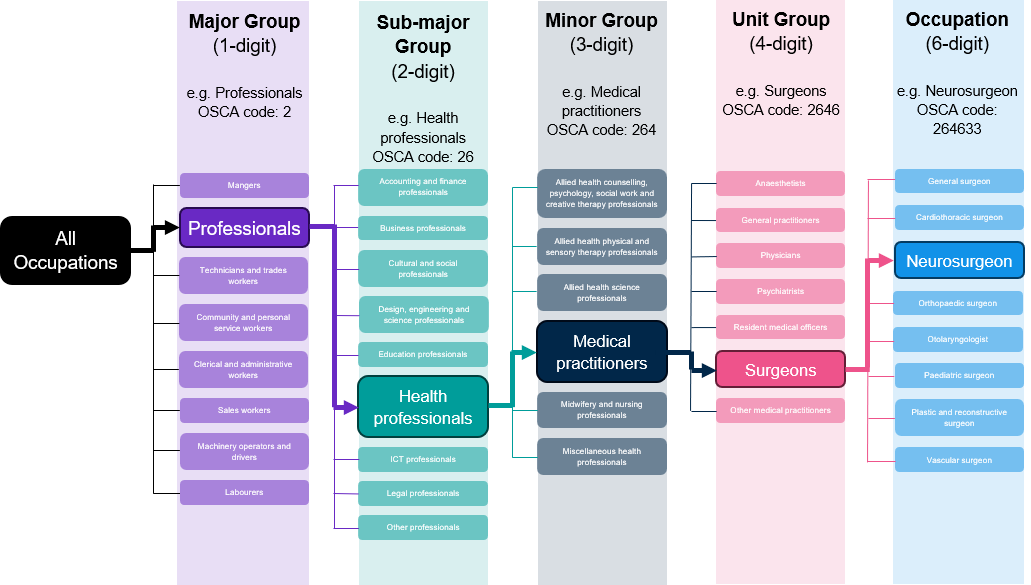
OSCA uses a classification hierarchy to divide all occupations into 8 major groups which are then divided into sub-major groups, minor groups, and so on. At each hierarchical level occupations are represented by a code with a specific number of digits:
| Hierarchy level | Example occupation | Occupation code |
|---|---|---|
| Major group | Professionals | 2 |
| Sub-major group | Health professionals | 26 |
| Minor group | Medical practitioners | 264 |
| Unit group | Surgeons | 2646 |
| Occupation | Neurosurgeons | 264633 |
The occupation profile pages on this website show information at two OSCA levels:
- 4‑digit Unit Groups
- 6‑digit Occupations
These levels are used because they provide clear, useful detail about occupations and match the data currently available from the ABS. Higher‑level groups (1‑, 2‑ and 3‑digit categories) are not shown here because they are too broad for understanding specific occupations.
Note: OSCA profiles include nec (“not elsewhere classified”) occupations but exclude nfd (“not further defined”) occupations.
Skill level
OSCA assigns occupations to one of five skill levels. An occupation's skill level is determined by the range and complexity of the set of tasks performed. The broader and more complex the set of tasks, the greater the skill level of the occupation.
Occupation skill levels consider the level of formal education or training, previous experience, on-the-job training, and/or personal attributes required.
While skill levels are described using formal education levels, some people use a combination of informal learning, on-the-job-training and personal experience to achieve an equivalent level.
| Skill level | Definition |
|---|---|
| Skill level 1 | Equivalent to a bachelor degree or higher. |
| Skill level 2 | Equivalent to a Diploma or Advanced Diploma. |
| Skill level 3 | Equivalent to a Certificate IV or Certificate III with at least 2 years' on-the-job training. |
| Skill level 4 | Equivalent to a Certificate II or III. |
| Skill level 5 | Equivalent to secondary education, or a Certificate I. |
For more information, please visit the ABS website: The OSCA Structure.